 Simple Paint Travel
Why Swat is Pakistan's easiest great valley
Every mountain region in this blog asks something of you — altitude, jeeps, buffers, nerve. Swat asks only that you come. The Swat Expressway has cut the drive from Islamabad to around 4–5 hours, most of it smooth motorway-standard road; the valley floor towns sit at comfortable altitudes that trouble nobody; hotels, restaurants and hospitals are plentiful; and the scenery starts within the hour and never really stops. This accessibility is not a compromise — it is Swat's superpower. A family can leave Islamabad after breakfast on Friday and be eating river trout beside the Swat River by lunch, walk to a 1,500-year-old stupa in the afternoon, and ski or ride a chairlift the next morning. For international visitors, Swat pairs the full northern-Pakistan palette — snow peaks, alpine lakes, pine forest, living history — with the lowest logistical friction in the country. And because the valley is wide and its sights are spread out, Swat absorbs its many visitors gracefully: drive ten minutes past the famous stop and the riverbank is yours. First trip, family trip, or a gentle re-entry after the Karakoram's drama — Swat is the answer to all three.
Mingora and Saidu Sharif: the twin base towns
Swat's life centres on Mingora, the valley's commercial hub, and its quieter twin Saidu Sharif, the old princely capital — together they form one continuous town at the valley's southern gateway. Base yourself here for the first night: the bazaars for supplies and Swati shawls and caps, the riverside for evening walks, and two sights that anchor the valley's story. The Swat Museum in Saidu Sharif holds one of Pakistan's finest Gandhara collections — serene Buddhas, carved panels and coins from the valley's Buddhist golden age — and an hour inside it will transform every ruin you see afterwards from 'old stones' into a civilisation. Nearby stands the White Palace at Marghazar, the Wali of Swat's summer residence, built of white marble in the 1940s and now a hotel and picnic spot in the hills — go for the drive and the gardens. Mingora's food scene is the valley's best: chapli kebabs, Swati pulao, and the first of many trout dinners. Treat the twin towns as your valley headquarters — sleep here, day-trip up the valley, and return each night to a proper bed and a bazaar that never quite sleeps.
The road up the valley: Bahrain, Madyan and the river road
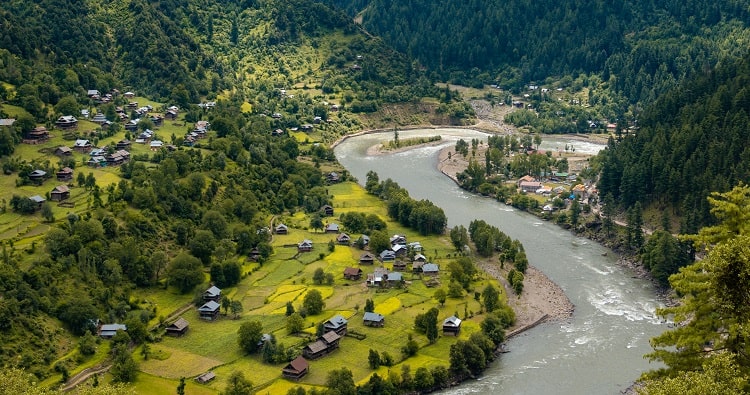
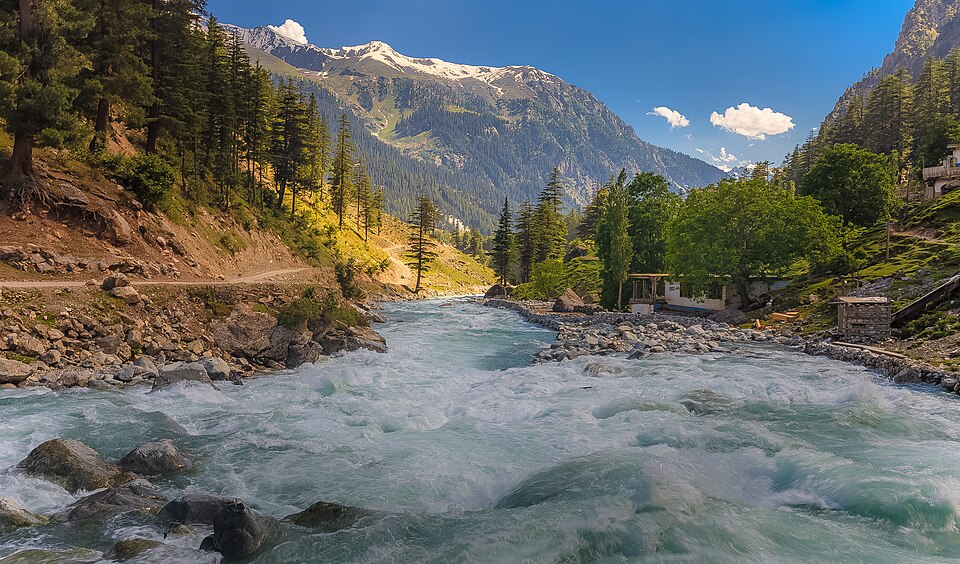
North of Mingora, Swat becomes a single beautiful idea: follow the river. The road to Kalam runs about 100 kilometres up the valley, and every kilometre earns its place. Madyan, the first resort town, spreads along the water with trout farms and riverside hotels — stop for lunch where the fish was swimming that morning. Bahrain, further up, is where the Daral and Swat rivers meet, and its bazaar, carved wooden souvenirs and riverside cafés make it the valley's favourite tea stop; the town takes its name ('two waters') from that meeting. Between and beyond the towns, the valley performs: terraced fields climbing to pine forest, walnut and poplar trees, villages of carved wooden balconies, and the river changing colour with the light — milky jade in the morning, deep green by evening. Drive it slowly, window down. This road is the reason 'Switzerland of Pakistan' stuck: not one famous viewpoint, but a hundred kilometres of continuous, inhabited, working beauty. Photographers, budget your memory cards for the journey, not just the destination — Kalam is lovely, but the road to Kalam is Swat showing off.
Kalam: the green summer heart of Swat
Kalam is where the valley opens into its alpine chapter — a wide, green bowl at about 2,000 metres where the Ushu and Utrot rivers join to form the Swat, ringed by pine-covered mountains and filled with hotels, bazaars and holiday energy. It is Swat's summer capital: families promenade the main street in the cool evenings, jeeps queue for the high valleys, and the air smells of pine resin and rain. Stay at least two nights. Use one for Kalam itself — the bazaar, the riverside, the old mosque with its carved pillars, and a trout dinner as the mountains turn pink. Use the other for the valleys above (next section). Kalam also teaches a Swat truth: the town is a base, not the sight. The travellers who love Swat most are the ones who treat Kalam as a trailhead with good food. A practical note: Kalam's popularity peaks hard in July–August and on holiday weekends, when prices rise and the main street hums until late; visit in May, June or September for the same valley in a calmer key, and book ahead whenever you come in season.
Above Kalam: Ushu Forest, Mahodand Lake and the high valleys
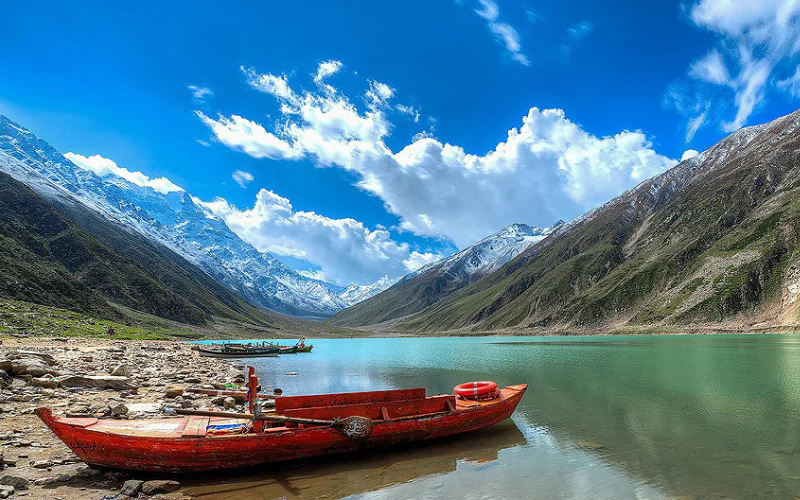
The jeep rides above Kalam are Swat's adventure core, and Mahodand Lake is their crown. The track climbs through the Ushu valley — first through one of the finest pine forests in Pakistan, where the trees are so tall and straight the light falls in columns — past the village of Ushu and the Paloga meadows, to Mahodand ('Lake of Fishes') at about 2,865 metres: a long, clear alpine lake cupped in meadows, famous for trout, ringed by peaks, and made for picnics, boating and horse rides. It is a full day from Kalam with the jeep ride as half the fun. The parallel Utrot valley leads to its own lakes and the trail toward the famous Kandol and Spinkhor lakes for trekkers, and shorter hops reach the Ushu glacier's snout. Honest notes: the tracks are rough — hire Kalam's local jeeps and drivers, start early, and carry layers, because Mahodand's weather can turn in an hour. In winter these valleys close under snow and belong to no one. In summer, they are the proof that Swat's 'gentle valley' reputation is only the ground floor: upstairs, Swat is as wild as anywhere in this blog.
Malam Jabba: skiing and chairlifts in the Hindu Kush foothills
Forty kilometres from Mingora, on its own mountain at about 2,804 metres, Malam Jabba is Pakistan's best-known ski resort — a fact that surprises people who think of Pakistan as desert and heat. In winter, its slopes carry real skiing and snowboarding, with rentals, instructors and a chairlift climbing to views that sweep the whole Swat valley; in summer, the same lift carries sightseers above green slopes, and ziplines and hiking fill the day. Malam Jabba makes an easy day trip from Mingora or a fun overnight, and for Pakistani families it holds a special place: this is where a generation of children first touched snow. Pair it with the valley's other winter face — Kalam under snow is a different, silent world — or visit in summer when the resort is a cool green escape from the plains' heat. Either way, it completes Swat's range: a single valley where you can swim in a river in May, picnic by an alpine lake in July, and ski in January. Not many valleys on Earth — Switzerland included — offer the set.
Swat's Buddhist soul: Gandhara heritage and the valley of a thousand stupas
Long before it was a holiday valley, Swat was a holy land. As part of ancient Gandhara, and known in texts as Uddiyana, it held hundreds of Buddhist monasteries and stupas; the Chinese pilgrim Xuanzang counted them in the thousands of monks. Their remains still freckle the valley, and visiting them is Swat's deepest pleasure. The Butkara I stupa near Mingora was excavated layer by layer, each dynasty enlarging the last; the great stupa of Shingardar stands visible from the road; the rock carvings of Jehanabad include a serene seated Buddha carved into a cliff face; and the Swat Museum ties the whole story together in stone. You do not need to be a historian to feel it: stand at a stupa at dawn, with the valley mist below and a 1,800-year-old monument above, and Swat's holiday cheer falls away into something older and quieter. It is also a point of pride that this heritage survived — protected by locals and archaeologists alike — and that the valley's people will happily direct you to 'the old Buddha' in their village. Add one heritage stop to every Swat day. The valley is prettier for its history, and so is every photograph.
The best time to visit Swat, and where to stay
Swat is the most forgiving valley in this blog for timing. Spring (March–April) brings blossom and fresh green; May–June is arguably perfect — warm days, full rivers, everything open, crowds not yet arrived. July–August is peak family season with monsoon showers greening everything further; September–October turns the valley gold and empties the hotels. Winter (November–February) is Malam Jabba's season and Kalam's quiet time — cold, clear and lovely if you pack for it. For stays: Mingora/Saidu Sharif for convenience and the museum, Madyan or Bahrain for riverside charm mid-valley, Kalam for the alpine chapter, and Malam Jabba for a resort night. Standards have risen fast — you'll find everything from simple guesthouses to proper hotels with generators and gardens — but book ahead for summer weekends. Food is a highlight everywhere: river trout (farmed locally, grilled or fried with Swati spices), chapli kebabs, and the valley's fruit — peaches, plums, persimmons and apples — sold at roadside stalls you will stop at 'just once', daily. Swat is Pakistan travel with the training wheels off and the smile on: come here first, and let it teach you how much you love these mountains before you test yourself on Hunza and Fairy Meadows.
Swat's food trail: trout, chapli kebabs and orchard fruit
Come to Swat hungry — the valley feeds travellers as a matter of honour. The signature dish is river trout, farmed in the cold streams around Madyan, Bahrain and Kalam and served grilled, fried or steamed with local spices in riverside restaurants where your table may literally overhang the water it came from. Around it, the valley's table fills out: chapli kebabs — Swat and its neighbouring districts argue proudly over the recipe — flat, tomato-crowned and fierce with green chilli; Swati pulao, gentler and more aromatic than its city cousins; fresh naan from tandoors that seem to burn at every bazaar corner; and kahwa, the green tea poured at every pause. Then there is the fruit, which follows you down every road in season: peaches and plums in summer, apples and the famous Swat persimmons in autumn, sold from roadside stalls where 'taste one first' is the entire sales technique. Dairy is a quiet glory too — the valley's lassi and fresh cheeses come from the same meadows you have been photographing. Budget a little extra time, if not money, for food in Swat: meals here are not refuelling stops between sights. Half the valley's social life happens across a table, and travellers who linger over lunch meet the Swat that drives past everyone else.
Swat with kids: why families choose this valley first
Ask Pakistani families where a child's mountain life should begin and Swat wins by acclamation — and the reasons are structural, not sentimental. The drive is the shortest of any great valley, mostly expressway, with no punishing single-day marathon. Altitudes stay kind: no jeep track here will test a child's lungs the way Deosai or Khunjerab can. The sights run on short attention spans beautifully — a chairlift at Malam Jabba, a boat on Mahodand Lake, a museum Buddha the size of a house legend, rivers to paddle at the edge of (supervised, always: mountain rivers are cold and fast, and this blog's rule is look, photograph, and keep little feet on the bank). Hotels with gardens, familiar food at every stop, and hospitals in Mingora complete the safety net that lets parents actually relax. There is a generational rhythm to it: parents who were brought to Swat as children now bring their own, staying in the same riverside towns, ordering the same trout. If your family is graduating from day trips to real journeys, Swat is the curriculum — and the children who start here tend to spend their adult lives working through the rest of this blog's list, one valley at a time.
A perfect 3-day Swat plan, day by day
Here is Swat compressed into a long weekend that families actually repeat. Day 1 — Arrive and go back 2,000 years: drive the expressway to Mingora by lunch, settle in, then spend the afternoon between the Swat Museum's Gandhara galleries and the Butkara stupa as the light softens; dinner is trout by the river. Day 2 — The river road: drive up the valley slowly — Madyan for a trout-farm lunch, Bahrain for tea above the meeting of the rivers — and reach Kalam by evening for a bazaar stroll and a cool mountain night. Day 3 — The high lake: jeep at dawn through the Ushu pines to Mahodand Lake for boating, horses and a meadow picnic, then roll back down the valley to Mingora and the expressway home, stopping at every fruit stall you swore you wouldn't. Swap Day 3 for Malam Jabba in winter (skiing and the chairlift) or if jeeps aren't your family's style. Notice what the plan never does: rush. Swat's genius is density without pressure — three days here feel like a week anywhere else, which is why this valley, of all the places in this blog, is the one travellers return to most. First the garden, as we said. Then the giants.
What to buy in Swat: emeralds, shawls and carved walnut wood
Swat's bazaars — Mingora's above all — are where the valley's crafts come to market, and they reward the unhurried browser. The famous name is emerald: the mountains near Mingora hold some of the world's most prized emerald mines, their stones a deep, bright green that has travelled from these valleys since antiquity; gems are sold in the bazaar's jewellery quarter, and the golden rule applies — buy stones only from reputable shops, at prices that make sense, ideally with local advice, and treat anything 'too cheap' as the souvenir it actually is. The safer glories are textile and wood: Swati shawls and embroidered caps, hand-loomed wool in the valley's patterns, and the carved walnut wood — boxes, panels and furniture in the intricate local style — that fills the Bahrain and Mingora craft shops. Add the edible luggage: dried fruits, walnuts, honey from the valley's beekeepers, and in season the fresh fruit that will not survive the drive home and will be eaten trying. Every purchase here does double duty — a keepsake for you, and income for the valley's makers, whose crafts are part of the heritage this guide keeps praising. Buy the story with the object: ask who made it and how. In Swat, the answer is usually a person, a village and three generations — and that is worth more than the discount you were about to request.