 Simple Paint Travel
Why Fairy Meadows is Pakistan's greatest mountain viewpoint
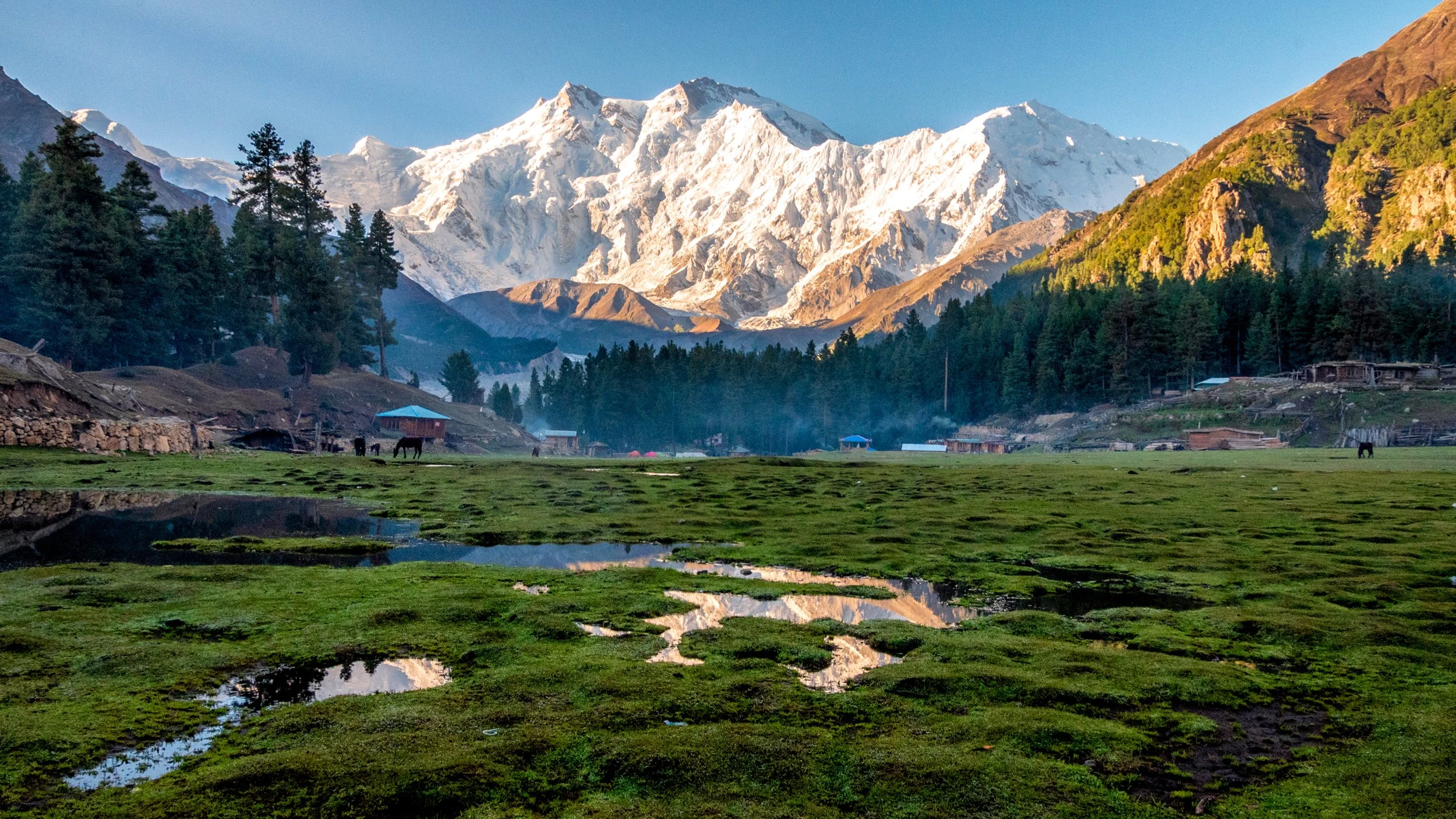
There are viewpoints in Pakistan where you see a great mountain. Fairy Meadows is where a great mountain sees you. Nanga Parbat's Raikot Face rises some 4,600 metres from the valley floor in one of the largest mountain walls on Earth, and the meadow sits directly opposite at about 3,300 metres — close enough that you hear the mountain: the crack and rumble of avalanches rolling off its flanks through the day. The foreground could not be gentler — green grass, pine forest, a still reflection pond, wooden cottages with smoke curling from their chimneys. That contrast is the whole magic: the softest meadow in Pakistan facing its most formidable mountain, the one climbers call the Killer Mountain for its fearsome history on other faces. You don't climb anything here. You sit on a cottage porch with tea, you walk to the pond at dawn, you watch light move across the Raikot Glacier like weather. Photographers plan trips around this meadow; poets ran out of adjectives a century ago. Arrive with at least one night to stay — a day trip to Fairy Meadows is like reading one page of a novel.
How to reach Fairy Meadows: Raikot Bridge, the jeep track and the hike
Every Fairy Meadows journey has three acts, and you should know all three before you set off. Act one: reach Raikot Bridge on the Karakoram Highway, about an hour's drive from Gilgit (or a stop on the road between Hunza and Babusar, as in our itinerary). Act two: the jeep track. From Raikot, local jeeps — and only local jeeps, driven by men who know every stone — climb the track to Tato (Jail) village: roughly an hour to ninety minutes of steep, narrow, cliff-hugging mountain road that is simultaneously terrifying and magnificent. It is widely called one of the most dangerous roads in the world; it is also, in the hands of its drivers, a daily routine, and the standard way in. Act three: the hike. From Tato, a clear trail climbs through pine forest for about 2–3 hours at a steady pace to the meadow; horses can be hired for luggage or for tired legs. There is no road to the meadow itself, no shortcut, and no shame in taking the hike slowly — the forest is beautiful, the first glimpse of Nanga Parbat through the trees is a moment people remember, and the meadow isn't going anywhere. It has waited rather a long time already.
The jeep track: what it is really like (and how to handle it)
Let's be honest about the track, because honest is this blog's whole job. The Raikot–Tato track is narrow, unpaved, cut into a steep mountainside, with drops on one side that you will think about. It is also maintained, constantly driven, and operated by a local jeep union whose drivers have run it thousands of times. Accidents are rare precisely because the system is strict: only authorised local jeeps, one track etiquette, and drivers who treat the road with the respect it demands. How to handle it: ride in the morning when you are fresh; sit in the middle seats if heights bother you; keep hands and cameras inside on the narrow sections; and don't let fear edit the experience — most passengers end the ride grinning, with the mountain views growing bigger at every switchback. If the track truly is beyond your comfort, the honest alternatives are to admire Nanga Parbat from the KKH viewpoints near Raikot and Chilas, or from Deosai's Sheosar Lake on a clear day. But if you can do it, do it. The meadow on the other side of that track is the reward the mountain gives to people who make the effort.
The hike from Tato: forest, first views and arriving
The trail from Tato village is the friendliest part of the journey — a well-worn path climbing gently-to-moderately through pine and juniper forest, with the sound of the Raikot stream below and woodpeckers at work above. Fit walkers do it in about two hours; a relaxed pace with photo stops takes three, and there is no prize for speed. You'll pass small clearings and the first cottages of the meadow's edge, and then the trees thin, the ground levels into green — and Nanga Parbat is simply there, enormous, white, filling the southern sky. First-time visitors reliably do the same things: stop walking, say something inadequate, take a photograph that cannot possibly work, and then just stand there. Let yourself. Practical notes: carry water (streams exist but treat or buy bottled at cottages), wear shoes with real grip — trainers survive in dry weather, boots are better — and keep a warm layer reachable, because the meadow at 3,300 metres cools fast when the sun leaves the mountain. If altitude catches you, sit, hydrate, and let the meadow do the work; most people adjust within hours at this height.
What to do at Fairy Meadows: the pond, Beyal Camp and the glacier
Fairy Meadows rewards slowness, but it does have a greatest-hits list. First, the reflection pond: a small, still pool in the meadow that mirrors Nanga Parbat on calm mornings — be there at dawn, before any breeze, for the photograph of your life. Second, the walk to Beyal Camp: a gentle 1–2 hour continuation through forest and meadow that brings you noticeably closer to the Raikot Glacier, with a viewpoint where the ice river and the great wall of the mountain dominate everything. Strong walkers can push on toward Nanga Parbat base camp (Raikot side) as a long, serious day — arrange a local guide at the meadow and start before dawn if you do. Third, the unlisted activity that most visitors rate highest: doing nothing on a cottage porch as the light changes — gold, pink, blue dusk — and the stars come out over the Raikot Face in numbers that make city people quiet. Night at Fairy Meadows, with the mountain glowing faintly above a silent meadow, is worth the whole journey by itself. Stay two nights if your itinerary allows; our 7-day route manages one, and it is the night everyone wishes were two.
Where to stay: huts, cottages and camping (with real prices)
Fairy Meadows accommodation is simple, wooden and part of the charm — cottages and huts scattered through the meadow and forest edge, run by local families, with home-cooked food and million-dollar views. Verified current ranges: a basic hut runs about Rs 2,000–3,500 per night, while a cottage with meals included typically runs Rs 5,000–10,000 per night depending on size and season. Camping with your own gear is also possible in designated spots for a small fee — and waking in a tent facing Nanga Parbat is a strong argument for carrying one. Expect mountain simplicity: shared or basic bathrooms in the cheaper huts, limited electricity (solar and generator hours), no meaningful mobile signal, and food that tastes better than it has any right to at 3,300 metres — dal, vegetables, fresh roti, and tea, always tea. Book through your driver, hotel in Gilgit or Hunza, or by phone ahead in peak season (June–August), when the meadow fills. The best-located cottages are those facing the mountain across the pond meadow — ask for the view when you book; in Fairy Meadows, the view is the room.
The best time to visit Fairy Meadows
The meadow's season runs roughly May to September, and each month has its character. May brings the first green, wildflowers beginning, cold nights and quiet trails before the crowds. June and July are peak: the meadow at its greenest, all cottages open, warm days — and the most visitors, especially around holidays. August can bring monsoon-influenced cloud to the Raikot face; the mountain plays hide-and-seek, though the meadow itself stays lovely and the crowds thin. September is the connoisseur's month — clear, stable skies after the monsoon, golden light, cold nights, and the mountain reliably out. Outside the season, snow closes the trail and the cottages shut; winter ascents are expedition business, not tourism. Weather honesty: Nanga Parbat makes its own climate, and even in the best months the summit can hide for a day. This is the second reason to stay two nights — you are buying two dawns at the reflection pond, and the mountain usually honours at least one of them. In our 7-day itinerary, Fairy Meadows falls on Day 5, timed for the heart of the season.
Fairy Meadows on the 7-day route: how it fits
In our 7-day northern Pakistan itinerary, Fairy Meadows is Day 5 — and the placement is deliberate. By then you have flown into Skardu, crossed Deosai, and spent a day in Hunza; you are mountain-adjusted, camera-happy, and ready for the trip's emotional peak. The day runs like this: drive from Hunza down the KKH to Raikot Bridge, jeep up to Tato, hike into the meadow by afternoon, sunset at the pond, a night under the Raikot Face. Day 6 leaves after a dawn reflection session, hikes and jeeps back down, and continues over Babusar to Naran and Lake Saif-ul-Malook. It is a full, glorious, tiring pair of days — the kind travellers describe with their hands. If you are building your own route with more time, insert the extra night here or in Hunza; if time is short, protect Fairy Meadows and trim elsewhere. Of all the places in this blog, this is the one people cross oceans for.
Safety, altitude and honest advice
Fairy Meadows is safe in the ways that matter and demanding in the ways mountains always are. The jeep track is operated by experienced local drivers — use them, and only them. The hike is a trail, not a climb, but it is at altitude: the meadow sits around 3,300 metres, Beyal Camp higher, and base camp higher still, so walk slowly, hydrate, and treat headaches seriously. Weather turns fast; carry layers and rain protection even in July. There is no hospital, no ATM and no reliable phone signal at the meadow — bring cash, medicines, a power bank, and tell your hotel or driver your plans. Hire local guides for Beyal and beyond: the money supports the valley, and their knowledge of weather and trail is the real safety equipment. Finally, leave the meadow cleaner than you found it. Fairy Meadows has no road, which means everything — including rubbish — is carried in and out by people and horses. Carry your litter down. The fairy tale stays a fairy tale only if its visitors act like guests in it.
Nanga Parbat: the mountain across the meadow
It is worth pausing on the giant itself. Nanga Parbat (8,126 m) is the world's ninth-highest mountain and its westernmost 8,000er — the anchor of the Himalaya's far end. Climbers call it the Killer Mountain: its early expeditions suffered terrible losses, and its Rupal Face is among the tallest mountain walls on Earth. The face you see from Fairy Meadows is the Raikot Face — immense, glacier-draped, and (by Nanga Parbat standards) the gentle one, though 'gentle' is doing heavy lifting in that sentence. The mountain was first climbed in 1953 by Hermann Buhl, alone and without bottled oxygen, in one of mountaineering's legendary feats. From the meadow, all of this history hangs silently in the view: you are looking at a wall that has humbled the strongest climbers alive, from a lawn where horses graze. That is the essential Fairy Meadows feeling — extremity and softness in the same frame. Listen at dawn and dusk and you may hear the mountain working: ice cracking, small avalanches sighing off the flanks. It is not silent up there. It is busy being a mountain, and the meadow is close enough to eavesdrop.
What to pack for Fairy Meadows: the honest list
Because everything arrives on your back or a horse's, packing for Fairy Meadows is an exercise in honesty. The essentials: broken-in walking shoes or light boots with grip; warm layers including a proper insulated jacket (nights at 3,300 m bite even in July); rain protection, because mountain weather does not consult forecasts; sun defence — hat, sunscreen, sunglasses — because altitude sun is a liar that burns through cloud; a headlamp for cottage nights and dawn walks to the pond; a power bank, since charging is limited and your camera will work overtime; cash in small notes for jeeps, horses, huts and tea; any medicines you need, plus basics for altitude headaches; and a reusable water bottle to cut plastic in a place where every bottle is carried in and out by hand. Leave behind: heavy suitcases (soft bags only — they go on horses and jeep roofs), drones where local rules or cottage owners object, and any plan that depends on phone signal. Pack light enough to enjoy the hike, warm enough to enjoy the night, and leave room in the bag: you will come down with photographs, a head full of stars, and almost certainly a resolve to return with more time.
Fairy Meadows for photographers: dawn, dusk and the Milky Way
If you carry a camera, Fairy Meadows will reorganise your sleep schedule, and you will thank it. Dawn is the headline act: reach the reflection pond before first light, when the air is stillest, and watch Nanga Parbat assemble itself in the water — summit first, then the face, then the whole mountain standing twice, once in the sky and once at your feet. Stay through sunrise as the light walks down the Raikot Glacier. Dusk is the second show: the meadow's cottages light their lamps, woodsmoke rises through the pines, and the mountain turns the famous alpenglow pink before fading to a luminous grey ghost against the darkening sky. Then night: with no light pollution and thin high air, the Milky Way pours over the Raikot Face in a density city photographers dream about — a tripod, a warm jacket and patience are the whole equipment list. Practical notes: batteries drain faster in the cold, so keep spares warm in a pocket; the meadow's horses and cottage porches make perfect foregrounds; and the hike in offers its own frames — the first reveal of the mountain through the pines is a photograph every visitor takes and none regret. Shoot the dawn, nap at noon, shoot the dusk. That is the professional schedule here, and the meadow wrote it.
Other faces of Nanga Parbat: Rupal, Diamir and the KKH viewpoints
Fairy Meadows shows you Nanga Parbat's Raikot Face, but the mountain has other moods, and knowing them completes the picture. The Rupal Face, on the southern side reached via Astore and the village of Tarashing, is the giant's most staggering aspect — often cited as the tallest mountain face on Earth, a wall of rock and ice rising some 4,600 metres from the valley. Travellers based in Astore can stand beneath it in the Rupal Valley's meadows: a wilder, less visited counterpart to Fairy Meadows, and the natural pairing with a Deosai crossing from that side. The Diamir Face, to the west, is the climbers' classic route side, seen distantly from the Karakoram Highway near Chilas, where roadside viewpoints frame the whole massif across the Indus gorge — on a clear winter morning, the highway view alone justifies the drive. And from Skardu's side, the mountain appears on Deosai's horizon above Sheosar Lake. Each face has its devotees; mountaineers argue the Rupal is supreme, romantics defend the Raikot across the pond. Our verdict, after drawing them all: Fairy Meadows wins for travellers, because it is the only face that comes with a meadow, a mirror, and a cup of tea. See the others on your way through — then come back to the lawn, and let the mountain perform for an audience of grass and quiet water.