 Simple Paint Travel
The second-highest plateau in the world: what Deosai actually is
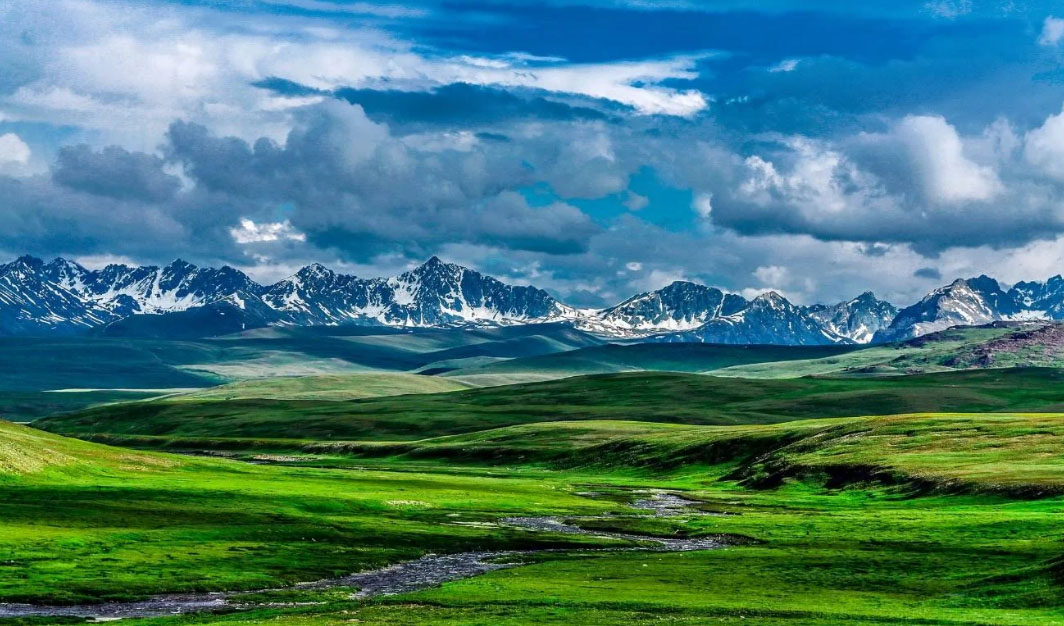
Only Tibet's Changtang plateau stands higher. Deosai averages about 4,114 metres above sea level — higher than most European summits — yet it is not a peak but a plain: tens of kilometres of gentle, rolling grassland suspended in the sky between Skardu, Astore and the Greater Himalaya. For most of the year it lies under metres of snow, locked and silent. Then, for a brief summer, it detonates into life: wildflowers in waves of yellow, purple and white; streams swollen with meltwater; migrating birds; and a sky so big it recalibrates your sense of scale. Standing on Deosai, you understand geography differently — this is the roof beam between worlds, the high corridor where the Karakoram's dry drama softens toward Kashmir's green. It is also fragile: the plateau's ecosystem runs on a few short months of growth, which is why the national park rules (stay on tracks, carry out everything, never approach wildlife) are not bureaucracy but survival instructions for a place that heals slowly. Travel here as you would enter a cathedral: quietly, and on its terms.
The bears were here first: Deosai's wildlife
Deosai's most famous resident is the Himalayan brown bear — a subspecies found in only a handful of high refuges, and the reason the national park was established in 1993. A few dozen bears roam the plateau, digging for marmots and roots, fishing the streams, raising cubs in a landscape that has been theirs since long before any road. Seeing one is luck, not itinerary: most visitors don't, and the plateau is no poorer for it — the possibility itself changes how you move through the place, scanning the green, respecting the distance, feeling properly like a guest. The supporting cast is rich: golden marmots everywhere, standing sentry and whistling alarms as your jeep passes; red foxes; Himalayan ibex on the rocky edges; wolves, rarely seen and often heard about; and birds in summer profusion — hoopoes, finches, wagtails and raptors riding the plateau's thermals. The trout streams (Bara Pani and Kala Pani) run clear and cold. A note on ethics that this blog will not soften: never feed wildlife, never chase an animal for a photograph, and if you do meet a bear, it is always — always — the bear's meadow. Back away, give ground, and treasure the story. The bears were here first.
Sheosar Lake: the jewel at the plateau's edge
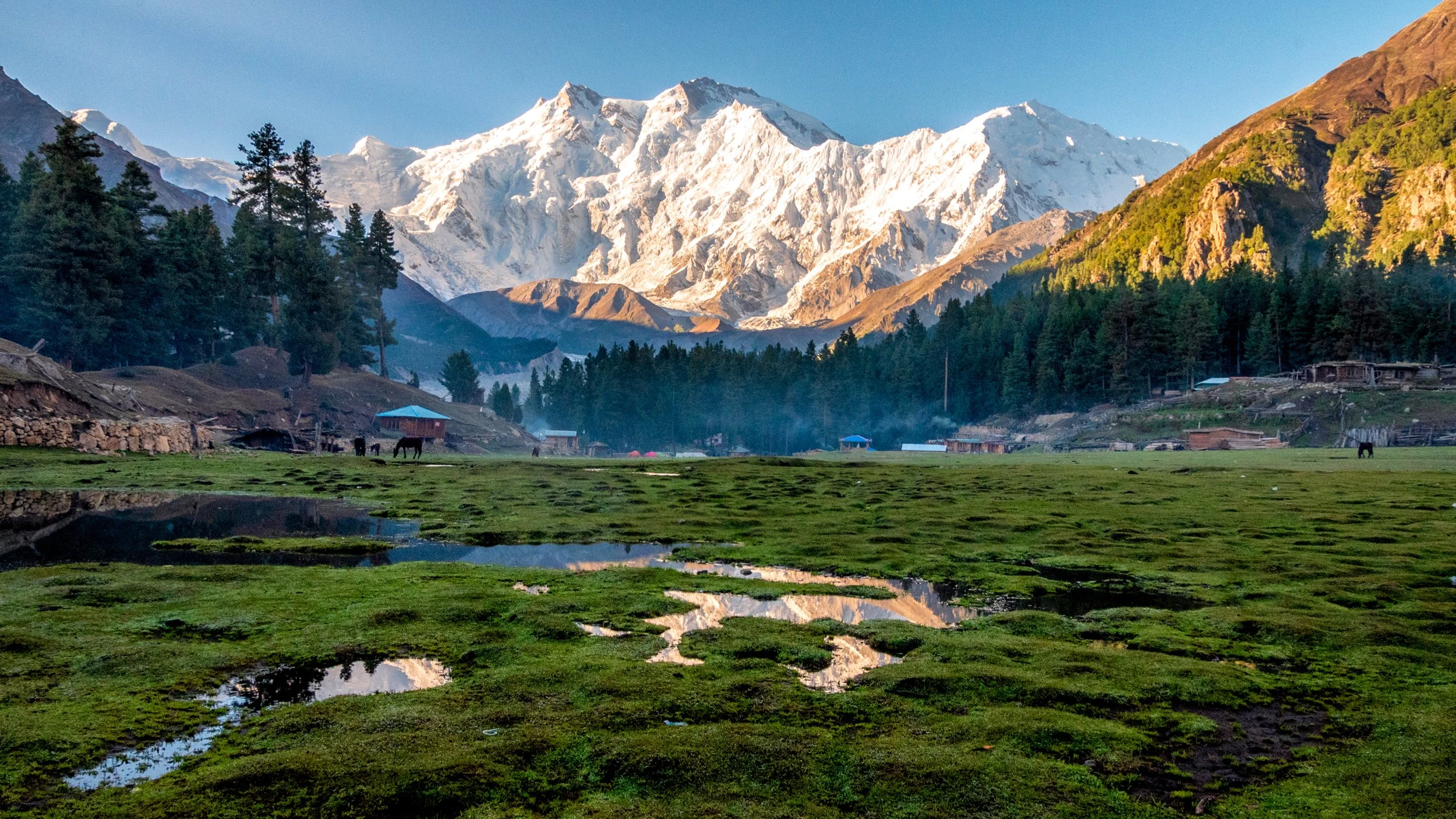
At Deosai's western edge, at about 4,250 metres, lies Sheosar Lake — 'Blind Lake' in the local language, though nothing about it is hidden. Sheosar is deep, still and an intense alpine blue, cupped in green banks with the plateau rolling away behind you — and in front, on a clear day, the white wall of Nanga Parbat (8,126 m) standing on the horizon like a second sky. It is one of the great picnic spots on Earth, and one of the highest lakes in the world reachable by road. Most Skardu-side day trips make Sheosar their turnaround and emotional summit: tea from a flask, wind combing the grass, marmots posing on the shore rocks, and that mountain floating above the water. Photographers should pray for a calm morning — the reflection doubles the impossible. Sheosar also marks the plateau's crossroads: from here the track continues over the Burzil side toward Astore and the road down to the Karakoram Highway, or turns back across the plateau to Skardu. Either way, stand a while. Lakes at this altitude, under this sky, with that mountain watching, are not waypoints. They are destinations wearing waypoint clothes.
How to reach Deosai: from Skardu, from Astore, and the full crossing
There are two doors onto the roof. The Skardu door is the popular one: jeeps climb from Skardu town past Satpara Lake and up the long track onto the plateau — roughly 2–3 hours to the top depending on conditions — then roam the plateau's tracks to Sheosar Lake, returning the same way by evening, or camping overnight. This is the version in our itinerary (Day 2), and it suits most travellers: a huge day, back in a Skardu bed. The Astore door is the adventurer's: from Astore town in the south, a rough track climbs via Chillam onto the plateau's far side — longer, wilder, and the start of the great full crossing: Astore up, across the whole plateau past Sheosar, and down to Skardu (or the reverse), a journey of one very long day or, better, two with a camp between. The crossing is the connoisseur's Deosai — you feel the plateau's true scale only when it takes a day to traverse. Either route demands a proper 4x4 and a driver who knows the plateau; this is not self-drive terrain for visitors. Book jeeps in Skardu or Astore the day before, agree the route and hours precisely, and start early — Deosai's weather writes its own afternoon schedule.
The season: why Deosai opens for a few short weeks
Deosai's visiting window is the shortest in this blog, and missing it is the classic Deosai mistake. Snow locks the plateau from roughly October to June. The tracks usually become passable in late June or July as the melt clears, and the season runs to about September — with each month a different plateau. July is the great unfurling: tracks drying, rivers high, the first flower waves, bears active with cubs. August is peak bloom — the flower carpet at full stretch, the plateau at its most visited, and afternoon showers possible. September turns the grass to gold, empties the tracks, and sharpens the air toward winter; many veterans call it the finest month. Exact opening depends on each winter's snow — check locally in Skardu before committing, and build your itinerary so Deosai can slide a day either way. Our 7-day route puts Deosai on Day 2, straight after the Skardu arrival, precisely so a weather delay can borrow Day 3's flexibility. Winter is not a season here; it is a siege. The plateau's animals endure it so that summer can be what it is. Come in the window, and come grateful.
A Deosai day trip, hour by hour
Here is how the classic Skardu day unfolds — the day we filmed. Dawn: leave Skardu early with a packed breakfast, fuel, water and layers; the road climbs past Satpara Lake as the light turns the water to pewter. Morning: the track tops out onto the plateau and the world changes — suddenly there is no 'up' left, only 'across': grass to every horizon, the first marmots, the first river crossing at Bara Pani's wooden bridge. Midday: Sheosar Lake — picnic, photographs, silence; Nanga Parbat if the sky is kind. Afternoon: the slow roam back — Kala Pani river, flower meadows, bear-scanning stops (hope, mostly, but joyful hope), golden light raking the grass. Evening: the descent past Satpara as Skardu's lights come on, dinner, and the particular tiredness that only altitude and wonder produce. It is a 10–12 hour day and worth every minute. If you can, upgrade it: camp one night on the plateau (with a proper operator, warm gear and park permissions) and take Deosai at dawn and under its stars — the plateau at night, with the Milky Way standing on the grass, is among the great experiences of the Pakistani mountains.
Costs, permits and altitude: the practical chapter
Deosai logistics are simple but non-negotiable. Transport: a hired 4x4 jeep with driver for the day from Skardu (or a multi-day package for the crossing) is the main cost — prices vary with fuel and season, so agree the full route, hours and inclusions before you set off; within our 7-day trip's budget tiers (Rs 55–65k shared-budget, Rs 120–140k mid-range per person for the week), Deosai day is one of the bigger line items and the least regretted. Entry: the national park charges an entry fee at the checkpoint — carry cash and your ID. Altitude is the real planning factor: you will spend the day between 4,000 and 4,300 metres. Acclimatise first (our itinerary gives you a Skardu day at 2,228 m before Deosai — still, ascend symptoms-aware), hydrate aggressively, eat lightly, skip alcohol the night before, and tell your driver immediately if a headache turns serious; the cure for altitude sickness is descent, and the track down is right there. Pack for four seasons in one day: sun is fierce (hat, sunscreen), wind is constant, and rain or even snow can visit in August. There is no fuel, no shop and no signal on the plateau — everything you need rides in the jeep with you.
Deosai in the big picture: where it fits your Pakistan journey
Deosai is the hinge of the north. In our 7-day itinerary it sits on Day 2 between Skardu and the long drive to Hunza — the day the trip's scale jumps from valleys to sky. Travellers building longer journeys can use Deosai as the bridge to Astore and onward to Fairy Meadows via Raikot, making a grand loop of the whole region without backtracking. However you place it, Deosai changes the traveller: after a day where the horizon is grass in every direction and the only residents are bears and marmots, the famous viewpoints that follow feel almost crowded — almost. That recalibration is Deosai's gift. It is the least serviced, least signposted, least commercialised place in this blog, and for many of our viewers and readers it is the favourite. Protect your day for it. Check the season, hire the right jeep, pack the layers, and go up onto the roof of the world — where the bears were here first, the flowers run to the horizon, and the sky is the largest thing you have ever stood inside.
The flowers of Deosai: a carpet with a deadline
Every summer, for a few short weeks, the roof of the world blooms. Deosai's wildflower season is the plateau's great transformation: waves of yellow potentilla, purple geraniums, white anemones, pink and blue and crimson blooms in a rolling carpet that runs — genuinely, not poetically — to every horizon. The flowers are racing: at 4,114 metres, the growing season is a sprint between snowmelt and snowfall, so the plateau compresses a whole spring and summer of blooming into July and August, species overlapping in drifts of colour that shift week by week. Bees and butterflies work the carpet in improbable numbers; marmots graze it like a salad bar; and the bears time their feeding to its richest weeks. For travellers, the flowers change Deosai's whole register: the plateau in June is grandeur, but the plateau in flower is grandeur with its guard down — the world's second-highest plain dressed for a festival it throws every year whether anyone comes or not. Photographers should get low: a knee-level shot across the flower carpet to a snow peak is Deosai's signature image. And a gentle rule that matters here more than anywhere in this blog: never pick the flowers and never drive or walk off-track across the carpet. At this altitude, a crushed patch may take years to return. The show is free. Leave it running.
Deosai's rivers: Bara Pani, Kala Pani and the trout streams
A plateau this high should be a desert; instead, Deosai runs with water, and its rivers are the plateau's second landscape. Snowmelt gathers into streams that braid and bend across the grass — the famous crossings at Bara Pani ('Big Water') and Kala Pani ('Black Water'), where wooden bridges carry the track over clear, fast, trout-holding currents, and smaller streams like the Shatung that drains toward the Indus side. These waters feed two worlds: north to the Indus through Satpara, and south toward Astore's river — Deosai is a watershed standing on the roof between them. For travellers, the rivers are the plateau's punctuation marks: stop at Bara Pani's bridge and the whole scale of the place composes itself — water in front, grass beyond, peaks at the rim, marmots on sentry duty. The streams run gin-clear and bitterly cold; their brown trout, introduced in the colonial era and now thoroughly at home, rise in the evening pools. Fishing requires permits and restraint — check the park rules, and consider catch-and-release the local courtesy in a protected ecosystem. What the rivers teach, standing on those bridges, is the plateau's secret: Deosai is not barren height. It is a wetland in the sky, and everything that lives here — flower, marmot, bear — is drinking from the same cold, bright water you are photographing.
Camping on Deosai: how to spend a night on the roof
A day trip shows you Deosai; a night up there introduces you. Camping on the plateau — with a proper operator, park permissions, and expedition-grade warmth — is among the great experiences of the Pakistani mountains, and it runs on its own rules. The evening is the overture: day-trip jeeps descend, the light goes long and gold across the grass, and the plateau empties into a silence so complete you hear the rivers thinking. Then the cold arrives — real, sub-zero-capable cold even in August — and the sky answers it with the Milky Way standing on the horizon in a band so dense it casts the night in silver. Bears are a practical consideration, handled the local way: food stored properly, camp kept clean, and your operator's experience doing the quiet work; the plateau's other night residents (foxes, hares, the occasional wolf's howl traded between ridges) are pure theatre. Dawn repays the cold in full: frost on the tent, mist on the streams, marmots emerging into first light, and the whole flower carpet lit from the side before any day visitor reaches the top. Do it once, properly equipped, and you will understand why travellers who camp Deosai talk about the plateau the way sailors talk about the open sea. Day trips visit the roof of the world. Campers sleep on it — and wake up changed.
Deosai from Astore: the southern door and the road less travelled
Most visitors meet Deosai from Skardu, but the plateau has a second door, and it opens onto a different journey. Astore, the town in the valley south of the plateau, is reached from the Karakoram Highway near Jaglot or from Gilgit — a green, river-cut valley in its own right, famous as the gateway to Nanga Parbat's Rupal Face at Tarashing. From Astore, the track climbs through Rama's meadows and past Chillam Chowki onto Deosai's southern rim — a longer, rougher and quieter ascent than the Skardu side, through country where the plateau announces itself gradually: first the trees thin, then the grass takes over, then the sky wins entirely. Travellers who enter this way usually do so as part of the great crossing — Astore up, the full traverse past Sheosar Lake, and down to Skardu — which remains the single finest way to understand Deosai's scale: a whole day of grass and river and sky between two towns, with the plateau as the entire middle of the story. The Astore side rewards its fewer visitors with emptier tracks, the plateau's southern flower fields, and the satisfaction of the road less travelled. Practical notes mirror the Skardu side, doubled: hire Astore's experienced jeep drivers, carry everything, confirm the track's condition locally (the southern ascent opens and closes on its own schedule), and give the crossing two days if you possibly can. Deosai has two doors. Walk through both, across the roof, and the plateau is yours for life.