 Simple Paint Travel
Why Skardu is the gateway to the greatest mountains on Earth
Every mountaineering map of the Karakoram funnels through Skardu. Expeditions to K2, Broad Peak, Gasherbrum I and II stage here; porters, jeeps and supplies for the Baltoro all flow out of this one small town on the Indus. That gives Skardu an atmosphere no other Pakistani town has — part frontier bazaar, part basecamp, part lakeside holiday town. In summer you will share your breakfast with climbers from six countries and trekkers heading for Concordia, then drive twenty minutes and have a mirror-still lake entirely to yourself. The Indus River, grey-green and enormous, slides past the town; across it, the road climbs to Kharpocho Fort and the whole valley opens. Skardu rewards both kinds of traveller: the one passing through to somewhere higher, and the one who realises — usually around sunset on the first day — that this is somewhere. Plan two full days minimum. Our itinerary gives Skardu Days 1 to 3, and honestly, it earns them.
How to reach Skardu: the Islamabad flight and the long road
The Islamabad to Skardu flight is the single greatest shortcut in Pakistani travel — and one of the most spectacular flights on Earth. On a clear morning the plane threads between Nanga Parbat and the Karakoram wall, wingtips seemingly close enough to touch the snow, and lands at Skardu's small airport in about an hour. The catch is the phrase 'on a clear morning': flights are weather-dependent and cancellations happen, which is why smart itineraries put Skardu first — a delayed start is recoverable, a delayed finish is not. The road alternative is an epic in itself: from the Karakoram Highway near Jaglot, the Skardu road follows the Indus gorge for some 170 kilometres of cliff-edge driving. It has improved greatly in recent years, but it remains a full, long day from Islamabad with an overnight stop for most travellers. Our advice mirrors our video: fly in, drive out. Take the flight to Skardu, then let the trip home roll downhill through Deosai and Hunza — you get the drama of the roads without gambling your first day on them.
Shangrila and the Kachura Lakes: Skardu's famous postcard
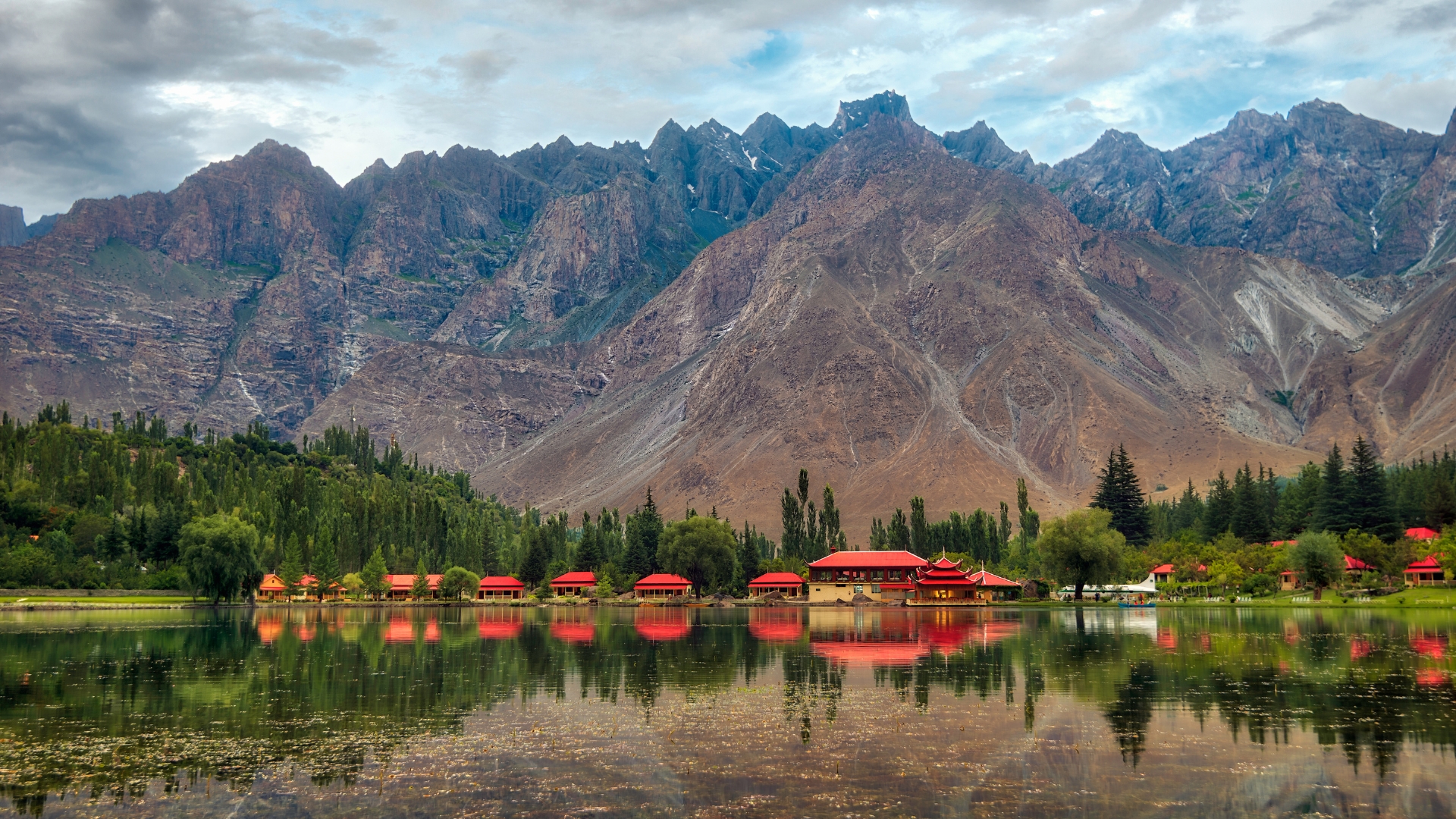
Ask anyone to picture Skardu and they will describe Lower Kachura Lake — better known by the name of the resort on its shore, Shangrila. The scene is almost suspiciously perfect: pagoda-roofed cottages in orchards, a still green lake, and the Karakoram standing in a ring around it all, doubled in the reflection. Come early in the morning before any breeze touches the water, walk the lakeside path, and take the photograph — everyone does, and it never gets old. Then do what most visitors don't: continue a few kilometres to Upper Kachura Lake. Upper Kachura is Shangrila's wilder sibling — deeper, darker blue, ringed by cliffs and orchards, with trout farms, small cafés and boats, and a fraction of the visitors. The two lakes together make a perfect half-day from town, and they teach you Skardu's rhythm: one famous view, and one quieter, better one hiding just past it. That pattern repeats all over this valley, so keep walking past the postcard. You will rarely be sorry.
The Katpana Cold Desert: sand dunes under snow peaks
Twenty minutes from Skardu town, the landscape does something impossible: it turns into a desert. The Katpana Cold Desert rolls pale sand dunes — sculpted, rippled, photogenic dunes — across the valley floor, while snow peaks stand on every horizon and the Indus glints nearby. It is among the highest cold deserts in the world, and walking its dunes at golden hour, barefoot on cool sand with mountains in every direction, is one of the strangest and best experiences in Gilgit-Baltistan. Come in the late afternoon when the light turns the dunes to sculpture and the heat (such as it is at this altitude) fades; stay for a sky full of stars if your driver agrees. The desert also hosts jeep rallies and camping in season. A practical note: there is little shade and no water out on the sand, so carry both, and give the dunes at least an hour — they look small from the road and are anything but. Travellers racing from the airport to Deosai skip Katpana entirely. Don't be them.
Kharpocho Fort and old Skardu town
Above the town, on a rocky ridge where the Indus bends, stand the ruins of Kharpocho Fort — the 'King of Forts', built in the late 16th century by Ali Sher Khan Anchan, the great unifier of Baltistan. The climb from town takes under an hour, and the reward is the definitive Skardu panorama: the town below, the Indus sweeping past, the airport strip, the desert, the lakes' green valleys, and peaks in layers to every horizon. Go at sunrise or sunset and you may have the ramparts to yourself. Back in town, give the bazaar its due: Skardu's main street is the Karakoram's great supply depot, and between the trekking shops and apricot stalls you will find Balti handicrafts, dried fruit by the sack, and cafés full of expedition gossip. Skardu also makes a practical base — banks, mechanics, gear rental and the region's hospital are all here, which matters more than romance when a jeep breaks or a flight cancels. Treat the town as basecamp, not just a bed: stock up, sort your permits and plans, and meet the people who actually live in the mountains you're admiring.
Satpara Lake and the road up to Deosai
South of town, the road to Deosai climbs past Satpara Lake — a deep, calm sheet of water held by a dam, ringed by bare mountains that change colour through the day. Satpara is both a beauty spot and a threshold: beyond it, the track leaves the valley floor and begins the long ascent to the Deosai Plains, the second-highest plateau in the world. Many travellers only glimpse Satpara through a jeep window on Deosai day, which is a shame — a lakeside stop for tea on the way up (or a picnic on the way down, when the light is low and the water turns to metal) costs twenty minutes and pays back an hour of memory. Trout from these cold waters appear on Skardu menus; order it grilled with local spices and you will understand why Balti cooks are proud of it. If you are crossing Deosai to Astore rather than returning to Skardu, Satpara is your farewell to the town — the road from here belongs to marmots, rivers and sky. Either way, Deosai day starts at this lake: fill water bottles, check the weather, and climb.
Shigar Valley: the fort, the river and the road to Askole
Thirty minutes from Skardu, the Shigar Valley runs northeast toward the Baltoro — and it deserves a day of its own. Its jewel is Shigar Fort, a 17th-century palace-fort of the Amacha dynasty, restored into one of Pakistan's finest heritage hotels and museums: carved wooden balconies, a cool stone audience hall, and gardens where the Shigar River murmurs past. Even if you don't sleep there, tour the fort and take tea in its garden. The valley around it is Baltistan at its most fertile — wheat, barley, apricots and walnuts in a green ribbon between rock walls — with villages that have supplied porters to Karakoram expeditions for a century. Beyond Shigar town, the road roughens toward Askole, the last village before the Baltoro Glacier and the K2 trail; day-trippers can drive partway for the sheer drama of the gorge. Shigar is also the connoisseur's alternative base to Skardu town: quieter, greener, and closer to the mountains' mood. If your schedule has a spare day anywhere in Baltistan, spend it here — or on Deosai. Both answers are correct.
Skardu as basecamp: Deosai, Hunza and Fairy Meadows connections
Skardu's greatest travel value is positional. From this one town, three of Pakistan's legendary journeys begin. North-west, the Deosai road climbs to the plateau and can cross it entirely to Astore — the route our 7-day itinerary drives on Day 2 before returning. West, the Indus road and Karakoram Highway carry you to Hunza in a long, magnificent day (about 286 km) — Day 3 of the same trip. And from Hunza's side of the mountains, Fairy Meadows waits beyond Raikot Bridge. This is why we fly into Skardu and drive out: it converts a map of separate destinations into one continuous story, each day beginning where the last ended. When planning your own version, remember the golden rules of Skardu-as-basecamp: confirm jeeps and drivers the day before, keep fuel and cash topped up (card machines and ATMs thin out fast beyond town), and never schedule a tight connection on Deosai day — the plateau runs on mountain time, and it is right to.
Where to stay and what to eat in Skardu
Skardu's hotels line the road from the airport into town and cluster near the bazaar, ranging from expedition lodges with gear drying in the courtyard to comfortable mid-range hotels and the famous lakeside resort at Shangrila. For most travellers, a well-run mid-range hotel in or near town is the sweet spot: hot water, a generator that actually works, and staff who can conjure a jeep, a mechanic or a rebooked flight with one phone call — in Skardu, that network is worth more than thread counts. Book ahead in June–August; the town fills with trekkers and tour groups. Eating in Skardu means Balti flavours: try mamtu (steamed dumplings), hearty meat-and-apricot stews, local trout, and the valley's dried apricots, mulberries and walnuts sold in the bazaar. Bakeries do a brisk trade in the mornings — stock up before Deosai day. And take one piece of advice from every traveller who has passed through: eat a big breakfast. Skardu days start early, run long, and the mountains do not cater lunch.
What a Skardu trip costs, and how long to stay
Skardu's costs split into three buckets. Getting here: the Islamabad flight is the premium option — priced like the hour of magic it is — while the road costs less money and more time. Staying here: lakeside resorts and heritage properties like Shigar Fort sit at the top; town hotels and guesthouses are genuinely good value, especially outside the June–August peak. Moving around: jeeps are the real budget item — Deosai days, Shigar trips and the Hunza run are usually hired as full-day or multi-day packages with a driver, and prices climb with fuel and season, so agree everything in advance and in writing where you can. Within our 7-day route, Skardu's three days typically account for a healthy share of the trip's Rs 55–65k budget / Rs 120–140k mid-range totals — mostly transport, and worth every rupee. How long to stay? Two nights is the minimum that does the lakes and desert justice; three nights (our plan) adds Deosai without rushing; four lets you add Shigar properly. If a flight cancellation gifts you a fifth, the town will not run out of sunsets to give you.
Manthokha Waterfall and the Kharmang Valley side trip
When Skardu's famous sights are done and a day remains, point the jeep southeast into the Kharmang Valley, where the Indus runs green between orchards and the road leads to Manthokha Waterfall — one of Baltistan's favourite picnic places. The fall pours in a bright curtain from a side valley into a pool ringed by cafés and willow shade, and on summer weekends it fills with Balti families doing what travellers everywhere do: eating well near loud water. The drive itself is half the reward — the Indus in one of its greener moods, villages of apricot and mulberry, and a valley noticeably softer than Skardu's stark grandeur. Manthokha pairs naturally with a slow return through the valley's orchards, stopping for fruit straight from the tree when it is offered (it will be). It is also a gentle day for travellers resting between the big efforts of Deosai and the Hunza road: low altitude, easy walking, and scenery that soothes instead of stuns. Not every day in the Karakoram needs to be an expedition. Some days should just be a waterfall, a picnic and a river — and Kharmang is where Skardu keeps those days.
Skardu in the shoulder seasons and winter
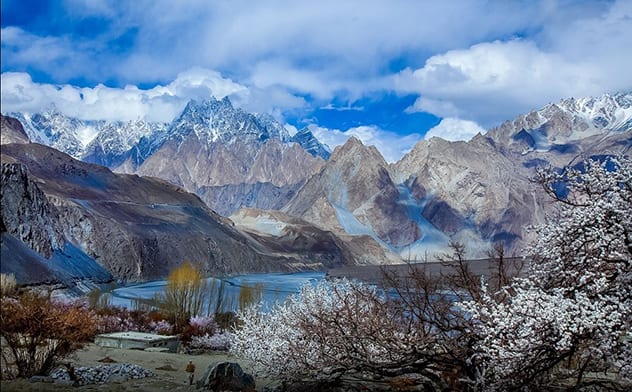
Most visitors meet Skardu between May and October, but the town has other faces worth knowing. April brings apricot blossom to the valleys while the peaks still hold deep snow — photographers who come for blossom season in Hunza often forget Baltistan blooms too, in quieter orchards with the same white giants behind. Late October turns the poplars and apricot trees gold, empties the hotels, and sharpens the light on the Kachura lakes to a blade's edge; services thin but the welcome does not. Winter is another country: temperatures fall far below freezing, the lakes skin with ice, the Katpana dunes wear frost like powdered sugar, and Skardu becomes a small, self-sufficient town under enormous white silence. Winter tourism is growing — ice activities on frozen lakes have begun drawing visitors — but come prepared for cancelled flights, basic heating and short days, and it will reward you with the Karakoram at its most elemental. The lesson generalises across this whole blog: the famous season is famous for a reason, but the mountains do not close when the crowds leave. They just change the subject.
A perfect 3-day Skardu plan, day by day
Here is Skardu compressed into the trip we filmed and would repeat. Day 1 — Arrive and orient: fly in from Islamabad in the morning, settle into a town hotel, and spend the afternoon at the Kachura lakes — Shangrila for the postcard, Upper Kachura for the peace — finishing with sunset on the Katpana Cold Desert dunes. Day 2 — The roof of the world: the full Deosai day, up past Satpara Lake to Sheosar and the flower plains, back by dark for a Balti dinner and an early night. Day 3 — Forts and the green valley: Kharpocho Fort at sunrise for the definitive panorama, a bazaar hour for apricots and supplies, then Shigar Fort and its gardens for lunch — and if you are following our route, this is where the trip pivots: Day 4 is the great road to Hunza. Notice the rhythm: water, sky, history. Skardu contains all three in a day's radius, which is why it anchors the whole northern journey. Give it these three days and it stops being the place your trip starts. It becomes one of the places your trip was for.
What to buy in Skardu: apricots, crafts and Karakoram keepsakes
Skardu's bazaar is the Karakoram's store cupboard, and shopping here is both pleasure and practical support for mountain families. The edible list leads: dried apricots in a dozen forms — golden, sun-darkened, kernel-filled — plus dried mulberries, cherries, walnut halves by the kilo, and apricot oil, the valley's traditional treasure for skin and cooking alike. Buy from the bazaar's dried-fruit row, taste everything offered, and accept that your luggage allowance is now a negotiation. The craft list follows: Balti caps and embroidered waistcoats, walnut-wood carving, woven wool from the high valleys, and — for the careful buyer with a reputable shop — the region's gemstones, since Baltistan's mountains hold ruby, aquamarine and tourmaline country not far away; buy stones only where you trust the seller and the price reflects the risk. Trekking and climbing gear, new and expedition-secondhand, fills the outfitter shops — a rummage here is a Skardu tradition, and more than one famous summit has been climbed in boots bought on this street. Finally, the strategic purchase: supplies. Everything your onward journey to Deosai, Shigar or Hunza might need — snacks, batteries, warm socks, a better headlamp — is here and will not be where you are going. The bazaar rule is the mountain rule: buy it in Skardu, carry it with a smile, and let the town's shopkeepers send you up the road properly provisioned and slightly over the weight you planned.